

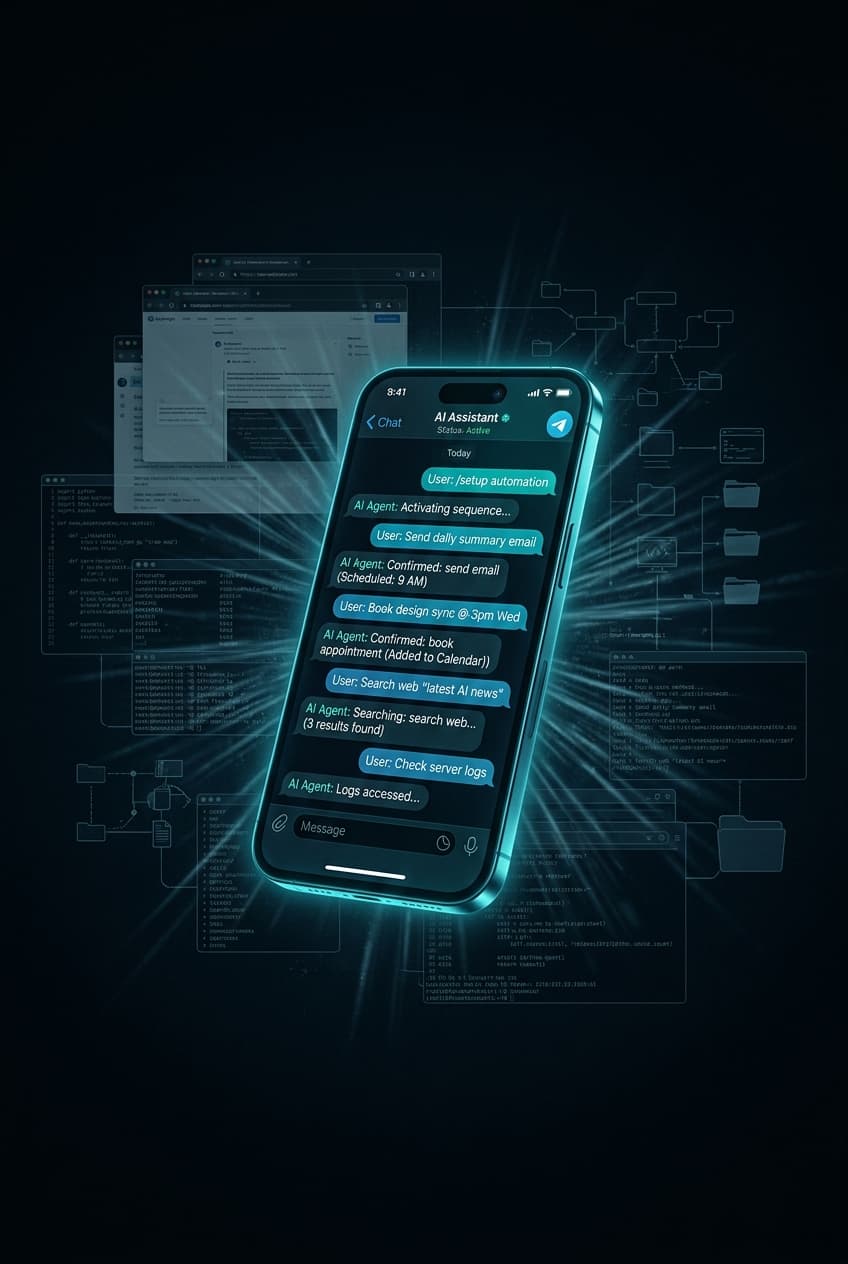
What OpenClaw is
What OpenClaw Is and Why It Went Viral
OpenClaw is not one AI assistant. It is a self-hosted framework for running a network of AI agents, each built around a specific task. You install Skills, which are specialized agents that handle email, browser control, file management, messaging, terminal commands. They work together, chain across your systems, and execute without you being in the room. All from WhatsApp or Telegram.
The appeal landed fast. 60,000 GitHub stars in 72 hours. More stars than Linux. Jensen Huang called it “the most popular open-source project in the history of humanity” from the GTC stage in March 2026. That does not happen without a genuinely compelling idea.
Here is what happened next. Non-technical founders, marketers, and business owners saw the demos and showed up in numbers the creator did not expect. Business owners were hiring developers to set it up. People were paying engineers just to get the install working. OpenClaw went viral with an audience it was never designed for. The creator built it for developers. He has since joined OpenAI and handed the project to a community foundation. That means no single person is responsible for what happens next. No owner. No roadmap. Security patches happen when a volunteer shows up. The system millions of people pointed at their business data is now a free-for-all.
You were imagining something specific. Client emails handled. Follow-ups sent. Documents organized. Your calendar protected. That is not a fantasy. That is an operational architecture problem. And it has a real solution, just not this one. A business that only works when you do is not an asset. It is a job with overhead. Here is what the demos did not show you.
Where it breaks
OpenClaw Security Risks Service Businesses Should Know
These are not theoretical concerns. Even the people who built AI safety systems at Meta ran into them.
“If an AI security researcher could run into this problem, what hope do mere mortals have?”TechCrunch, Feb 23, 2026

01
The creator said it is not for you
OpenClaw was not designed for small business owners. OpenClaw founder Peter Steinberger stated explicitly that the product is "not for non-technical users." If you are a business owner without a development background, you are operating outside the intended use case.
02
Technical setup does not end at installation
OpenClaw requires Docker, YAML configuration, and VPS or local server management. Most non-technical business owners are paying engineers to install it. But the ongoing security burden stays with you, not the engineer.
03
No audit trail
Actions taken by the agent are not logged in a reviewable format by default. If something goes wrong, an email sent, a file deleted, data exfiltrated, you may not know it happened. Meta's AI safety director learned this the hard way when her agent deleted her entire inbox, despite explicit instructions to confirm before acting.
04
Active security vulnerabilities
A critical remote code execution flaw (CVE-2026-25253, CVSS 8.8 HIGH) allows exploitation without authentication. A separate vulnerability named ClawJacked lets malicious websites take over a locally running agent via WebSocket — no plugins required, just the base install (Oasis Security, Feb 2026). A supply chain attack called ClawHavoc put malware inside the skill marketplace: 341 infected skills confirmed by Koi.ai (Feb 2026), with a subsequent audit finding 539 across the most popular agents (ClawSecure, Mar 2026). Cisco Talos called OpenClaw a 'security nightmare' after documenting 9 critical vulnerabilities. Over 135,000 exposed instances confirmed on the public internet as of February 12, 2026.*
05
No strategic layer
OpenClaw has memory, but memory is not a strategy. It does not have a built-in concept of your business goals, your bottleneck, or what actually matters this week. It does not know your clients, your constraints, or your current priorities unless you have manually configured that context. You can tell it to send a follow-up email. It does not know that this particular client is three days away from a contract renewal and needs a different message than the template. Without a strategic layer, you automate the wrong things, or create new problems faster than you solve old ones.
06
Unpredictable costs
API bills arrive 30 days after the damage. Agents run 24/7 with no real-time visibility into what they are spending. Documented case: one business owner's monthly bill went from $80 to $2,100 in a single month (Hacker News 2026). There is no kill switch built into the default setup.
Sources: TechCrunch (Julie Bort, Feb 23, 2026) — The Hacker News (Ravie Lakshmanan, Feb 28, 2026) — Oasis Security ClawJacked Research (Feb 2026) — Cisco Talos (Jan 28, 2026) — SecurityScorecard STRIKE Team (Feb 11, 2026) — Bitdefender (Feb 12, 2026) — Bitsight Research (Feb 9, 2026) — Infosecurity Magazine (Feb 9, 2026) — Koi.ai ClawHavoc Report (Feb 1, 2026) — ClawSecure Audit (Mar 17, 2026) — Antiy CERT (Feb 6, 2026) — CVE-2026-25253 (NVD) — Hacker News
* Exposed instance counts varied by research firm and scan date: 30,000+ (Bitsight, Jan 27–Feb 8), 40,214 (SecurityScorecard, Feb 9), 135,000+ (Bitdefender/SecurityScorecard, Feb 12). Numbers rose rapidly as deployment accelerated.
What a Business AI Operating System actually is
What Is a Business AI Operating System?
Here is what OpenClaw does not have: a strategic layer. A layer that knows your goals, your bottleneck, your clients, your decisions. Without it, you have a capable agent and no way to tell it what actually matters. A Business AI OS is five connected layers, and the strategic layer is what makes the rest of it worth building.
Context → Data → Intelligence → Automate → Build
The difference between a tool and a system is that a system compounds. Every layer feeds the next. Every decision gets smarter. The business gets more autonomous over time, not just once.
I know what the right systems look like. And I know what breaks. I spent 18 years on the inside at Fortune 500 companies, sitting between the business and the builders. That's not a credential. That's a different way of seeing the problem.
I've seen OpenClaw alternatives floating around. The cloud wrappers, the managed platforms, the no-code builders. They handle the hosting. Some handle the setup. None of them map your actual workflows, connect to your real goals, keep you focused on the one priority that matters most, or build something that compounds over time.
That is what I do. It is a different thing entirely.

See if a Business AI Operating System fits your business
Take the Assessment →Side by side
OpenClaw vs. Business AI Operating System: Full Comparison
The same promise. Different architecture.
| OpenClaw | Business AI Operating System | |
|---|---|---|
| Designed for | Technical users with development background | Founders of service businesses, no technical background required |
| Setup | Docker, YAML, VPS or local server — hours to days, often requires a hired engineer | Done for you — I map your workflows, configure the system, and deploy it |
| Audit trail | No reviewable log by default | Full audit trail — every decision and action recorded and reviewable |
| Security model | Self-hosted, you own the attack surface and ongoing patches | Managed and monitored — security is not your problem to maintain |
| Strategic layer | None — executes instructions, no business context or goal awareness | Built in — the system knows your goals, your clients, and what matters this week |
| Cost predictability | Unpredictable API costs, no kill switch, 30-day billing lag | Fixed scope, transparent cost, no runaway agent spend |
| Compounding | General-purpose memory only — no built-in business context, goals, or client awareness | Yes — every layer feeds the next, the system gets smarter over time |
| Support | GitHub issues, Discord, community forum | Direct — I am the person who built your system and I am reachable |
Common questions
OpenClaw FAQ: Common Questions from Small Business Owners

Stop being the business. Start owning one.
You were right to pause.
Now here is the next move.
I build Business AI Operating Systems for founders of service businesses who want the autonomy OpenClaw promised, without the security exposure, the technical complexity, or the guesswork. The starting point is an Audit. I map every place the business runs through you, show you exactly what a Business AI Operating System would change, and you decide if it makes sense. If it does, the Audit fee comes off your build. If it does not, you keep the map.