
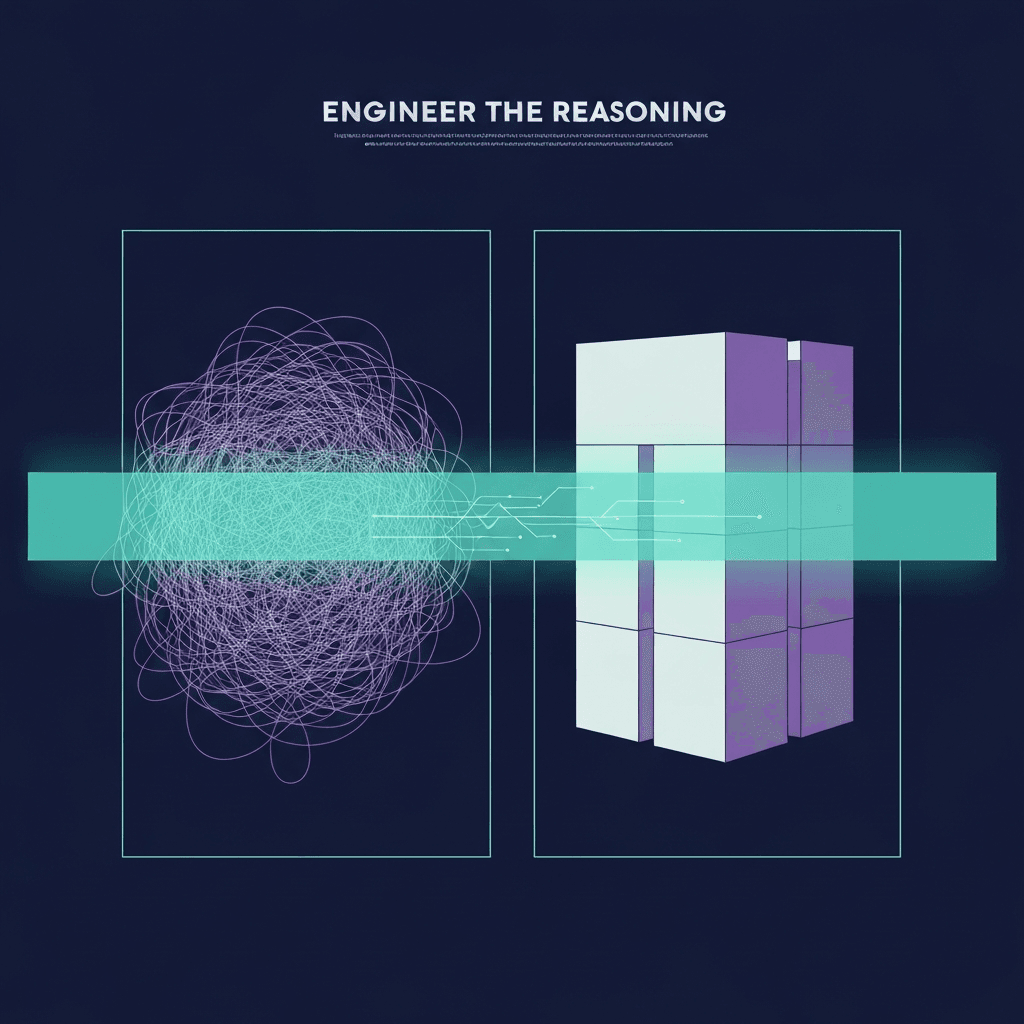
How to Prompt Claude's Extended Thinking Mode for Reasoning That Holds Up
The outputs feel almost right. Close enough that you keep using Claude, but not close enough that you can fully delegate. You add more context. You write longer prompts. The results get marginally better, then plateau. So you start wondering if you're doing something wrong, or if this is just the ceiling.
Claude's extended thinking mode is a prompting approach where the model allocates reasoning tokens before generating its response, working through uncertainty and competing factors internally before committing to an output. It exists specifically for decisions with real tradeoffs, not for simple tasks where a fast answer is good enough.
It's not the ceiling. It's the prompting model.
Most operators using Claude are prompting for answers. That sounds obvious, but it's the problem. Claude's extended thinking mode exists specifically to let the model reason before it responds, to work through uncertainty, weigh competing factors, and surface its own assumptions before committing to an output. When you skip that stage and prompt straight for the answer, you get a faster response that's also more likely to be confidently wrong on anything that requires genuine judgment.
Here's how to fix that.
What Is Claude's Extended Thinking Mode, and Why Do Most Operators Miss It?
Extended thinking is a mode where Claude allocates reasoning tokens before generating its response. Think of it as the model working through the problem internally before writing the answer you see. That internal process isn't visible in the output, but it meaningfully changes the quality of the conclusion.

Standard Claude prompting produces what I'd call single-pass outputs. The model reads your prompt and generates a response in one motion. That's fast and often good enough for simple, well-scoped tasks: summarize this, draft that, reformat this list.
But for anything that involves tradeoffs, edge cases, ambiguous inputs, or decisions with downstream consequences, single-pass outputs tend to flatten the complexity. Claude gives you an answer because you asked for one, not because it's fully reasoned through the problem.
Extended thinking mode changes the sequence. Before Claude writes the response you see, it runs a reasoning pass, working through the problem, noting uncertainty, considering alternatives, and that internal process shapes what comes out the other end.
Most operators miss it for two reasons. First, it's not the default behavior on most interfaces. You have to prompt toward it or enable it through the API. Second, operators who have tried it once often didn't see a dramatic difference, because they didn't change how they structured the prompt. Turning on extended thinking without restructuring your prompt is like switching to a faster engine without changing where you're pointing the car.
Why Does Standard Prompting Fail on Complex Reasoning Tasks?
Here's the pattern I see repeatedly. An operator writes a detailed prompt. Long context, specific instructions, maybe a few examples. They're front-loading information. The output is still thin on nuance, or it misses an edge case that seems obvious in retrospect, or it's technically correct but wrong for their specific situation.
The instinct is to add more to the prompt. More context, more constraints, more examples. Sometimes that helps. Often it doesn't, because the problem isn't information volume. It's reasoning architecture.
When you treat Claude like a better search engine, you optimize for input richness. When you treat it like a reasoning engine, you optimize for process structure. Those are different design problems.
The specific failure mode on complex tasks: Claude generates a response that satisfies the surface requirements of the prompt while bypassing the harder judgment call underneath. It looks complete. It uses the right vocabulary. But it didn't actually wrestle with the tension in the problem, because the prompt didn't create space for that.
This matters more when you're building repeatable workflows than when you're doing one-off queries. A single bad output is annoying. A bad reasoning step inside an automated workflow that runs every week is a system that erodes trust until someone catches it, or doesn't.
How Do You Prompt Claude's Extended Thinking Mode for Staged Reasoning?
Claude's extended thinking mode isn't primarily about keywords or toggle switches. It's about structuring your prompt so that reasoning is a required stage, not an assumed byproduct of good instructions.

Four things that actually change the output quality:
1. Separate the reasoning request from the answer request.
Don't ask Claude to analyze a situation and give you a recommendation in the same breath. Ask it to reason through the situation first, surface the key tensions, note what it's uncertain about, and then, separately, give you its conclusion. This creates a genuine reasoning pass rather than a post-hoc rationalization of a pre-formed answer.
A prompt structure that works: "Before giving me your recommendation, work through the following: what are the strongest arguments on each side, what information would change your answer, and where is your reasoning least certain. Then give me your recommendation with that context."
2. Name the decision structure explicitly.
Tell Claude what kind of reasoning the problem requires. Is it a tradeoff between two goods? A risk assessment? A prioritization under constraints? Naming the structure gives Claude a framework to reason inside instead of having to invent one. Invented frameworks are often generic. Specified frameworks are usually accurate.
3. Give Claude permission to be uncertain.
This sounds small. It's not. By default, Claude answers in a confident register because that's what most prompts implicitly reward. If you're asking for a recommendation, confidence reads as helpfulness. But on genuinely complex decisions, false confidence is worse than calibrated uncertainty.
Add explicit permission: "If there are aspects of this where the right answer depends on information I haven't given you, say so and tell me what you'd need." That single instruction shifts the output from confident-but-thin to honest-and-useful.
4. Stage multi-step problems across multiple prompts.
Extended thinking mode prompting works better when you don't try to compress a three-stage reasoning problem into one request. Run the reasoning pass first, review it, then ask for the recommendation. This isn't slower if you're building a workflow. It's more reliable, and reliability is what makes something delegable.
Where Does Extended Thinking Pay Off Most in Operator Workflows?
Not every task needs this. Summarization, formatting, first drafts, data extraction — those are single-pass tasks. Prompting for extended thinking on a simple task adds friction without adding value.
The tasks where extended thinking is worth the architecture: anything that would require a capable human to pause and think before answering. Pricing decisions with multiple variables. Hiring assessments where candidate profiles pull in different directions. Risk flags in contracts or proposals. Strategic prioritization when resources are constrained. Any decision where the right answer changes significantly depending on context you might not have fully specified.
I use this inside agentic workflows where a reasoning failure doesn't just produce a bad output. It breaks a downstream step or triggers an action that's hard to reverse. In that context, the difference between single-pass and staged reasoning isn't about average output quality. It's about whether the workflow holds on edge cases.
That's the real test. Not how Claude performs on the clean version of a problem. How it performs when something's slightly off, ambiguous, or outside the training examples of your prompt.
How Does the CRAFT Formula Work in Practice?
Describing these principles is one thing. Seeing them assembled into an actual prompt is another. Here's the structure I use, broken into five components, with a business owner example for each.
C — Context. The actual situation: constraints, tension, what's at stake. Not a summary. Enough detail that the answer changes based on your specifics, not a generic case.
R — Role. What expertise do you want Claude to bring? Not "be helpful." Be a pricing strategist. Be a hiring assessor. Be a contract risk analyst.
A — Action. What you want it to do, including the reasoning step. "Before giving me a recommendation, work through: what are the strongest arguments on each side, what would change the answer, and where is your reasoning most uncertain."
F — Format. How the output should be structured. Reasoning first, then recommendation, then the top things to verify before deciding.
T — Tone. Honest and direct. No reassurance if the situation is risky. Name that explicitly, because Claude will default to encouraging.
Here's what a real business decision looks like through this structure. A service business owner deciding whether to raise prices:
Context: I run a 6-person consulting firm. I'm considering raising prices for new clients from $4,000 to $6,000 per month starting next quarter. Current clients stay at their existing rate. I've had a waitlist for the last two months and three strong revenue quarters in a row.
Role: You are a pricing strategist who works with professional services firms.
Action: Before giving me a recommendation, work through what makes this increase likely to succeed, what could go wrong, and what information would change your answer.
Format: Reasoning first. Then your recommendation. Then the two things I should verify before deciding.
Tone: Direct. If this is risky given what I've told you, say that. I don't need encouragement.
That prompt produces a different output than "Should I raise my prices?" Both are asking the same question. One is asking for a quick answer. The other is asking for structured reasoning that acknowledges what it doesn't know.
The difference isn't prompt length. It's that the second prompt treats reasoning as a stage you design for, not something that happens automatically because your instructions are detailed enough.
That's the shift. Everything else is implementation.
If you're building with Claude inside a real workflow and hitting the ceiling on output quality, the prompting structure is usually where the problem lives. That's exactly the kind of issue I work through in a Discovery Call, not to sell you more tools, but to find the one or two architectural changes that close the gap between "almost delegable" and "actually delegable."
Or start here: How to Build an AI Operating System for a Sub-10 Person Knowledge Business