
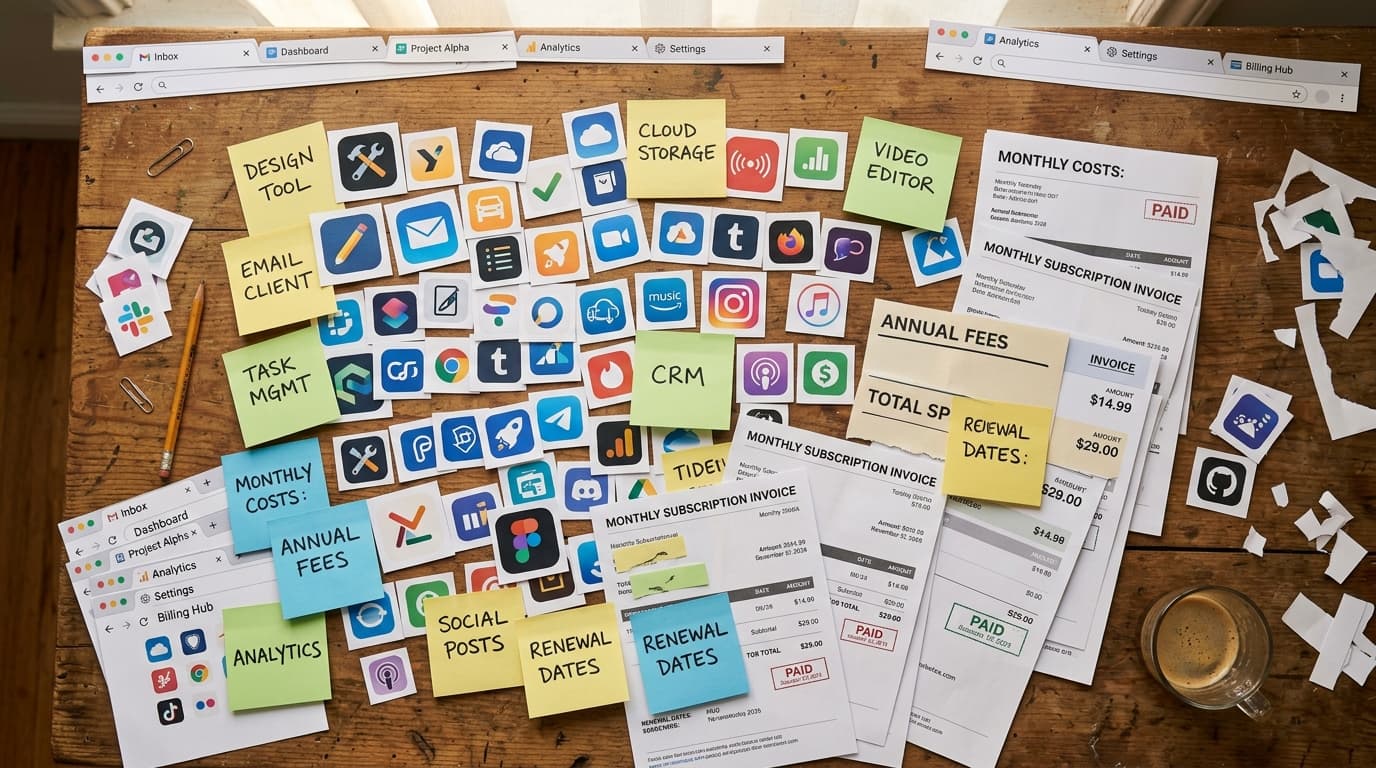
If you're using ai tools for small business and they're not talking to each other, that's not a tool problem. That's a system problem.
Here's the answer most people aren't getting: your AI tools aren't working together because they were never designed to. Each one starts from scratch every time you open it. It doesn't know your clients, your voice, your offers, or how you make decisions. You have to explain yourself, again, every single session. The tool isn't broken. The mental model is.
You don't have an AI strategy. You have a subscription list.

Why Don't AI Tools Add Up to a System?
Tools are stateless. That word matters. Stateless means each tool begins with zero memory of your business. It doesn't carry anything forward. It doesn't know what you told it last Tuesday or what your best client looks like or how you price a project.
So what happens when you buy five stateless tools? You get five separate starting lines. And you, the founder, become the connector between all of them. Every tool needs context. Every tool needs direction. Every tool needs you to show up and feed it what it needs to produce something useful.
That's not automation. That's a new job with a software subscription attached.
I've watched this exact failure mode play out across 18 years of building digital products, at companies like Virgin Mobile, Papa Murphy's, and Intermedia. The organizations buying the most software were often the ones drowning the hardest. They had dashboards, integrations, platforms. What they didn't have was a system designed around how the work actually moved. McKinsey's 2025 State of AI report found that while nearly 90% of companies deployed AI in at least one function, 94% report not seeing significant value from those investments. More tools without more structure is the same mistake, faster.
Small businesses are repeating the same mistake, just faster and cheaper.
What Does a Disconnected Tool Stack Actually Cost?
Most founders I talk to are paying for between 4 and 7 AI subscriptions. ChatGPT. Zapier. Something for email. Something for social. Maybe a scheduling tool with AI features bolted on.
The monthly cost isn't the issue. The real cost is what happens when none of it compounds.
You spend 20 minutes explaining your brand voice to a writing tool that forgot everything from last month. You build a Zapier workflow that breaks when someone renames a folder. You run the same research three different times in three different tools because nothing feeds into anything else.
The founder is still the connective tissue. And that means the business only moves when you're moving it. That's the definition of a bottleneck.
What Does a Connected AI System Actually Look Like?
A system doesn't start from scratch. It knows your business before you say a word.
It has captured your context: who you serve, what you sell, how you communicate, what decisions you've already made, and what's been tried. That context is persistent. It travels with every interaction. You stop explaining yourself and start directing work.
That's the difference between a tool and a system. The tool answers your question. The system knows what question to expect.
The connecting layer that makes this possible is context. Not another app. Not another integration. The captured, organized knowledge of how your business operates.
How Do You Audit What You're Already Paying For?
Before adding anything, look at what you have. For each subscription, ask three questions.
Does this tool know anything about my business beyond what I typed in the last session? If the answer is no, it's stateless. It's a tool, not a system asset.
Am I the one connecting this to everything else? If yes, you haven't removed a job. You've created one.
Has this subscription changed how I spend my time in a measurable way? Not "I use it sometimes." Has it actually shifted where your hours go?
If most of your answers point toward no, you don't have a strategy. You have a collection.
How Do You Move from Tool Collector to System Owner?
The shift isn't about buying better tools. It's about building the layer that makes tools useful.
That layer is context. Specifically, a Context layer that captures what your business knows and makes it available to every AI interaction you run. Your brand voice. Your client profile. Your pricing logic. Your standard operating decisions. Your service model.
Once that exists, tools stop being standalone apps and start behaving like members of your operation. They have something to work from. They don't need you to repeat yourself. They can produce outputs that actually sound like you and fit your business.
This is what a Business AI Operating System does that subscriptions can't. It's not a product you buy. It's an architecture you design around how your business actually works.

What Does a Business AI Operating System Do That Subscriptions Can't?
The question founders ask me most often is: "How do I know if my AI subscriptions are actually saving me time?" The honest answer is: if you have to ask, they probably aren't. Not in a meaningful way.
A Business AI Operating System changes that. It's built on four layers: Context, Data, Intelligence, and Automate. The first layer is the one most people skip entirely. Context is where the system learns your business. Everything else depends on it.
Without context, automation is just speed applied to chaos. You get faster outputs that still don't fit. You get more content that still doesn't sound like you. You get workflows that still break when reality doesn't match the template.
With context, the system starts to run without you narrating every step.
The goal isn't to replace your judgment. It's to stop requiring your presence for things that don't need it. And that starts with capturing what your business already knows.
If you want to map what you have and what's actually worth keeping, that's exactly what the AIOS Audit does.