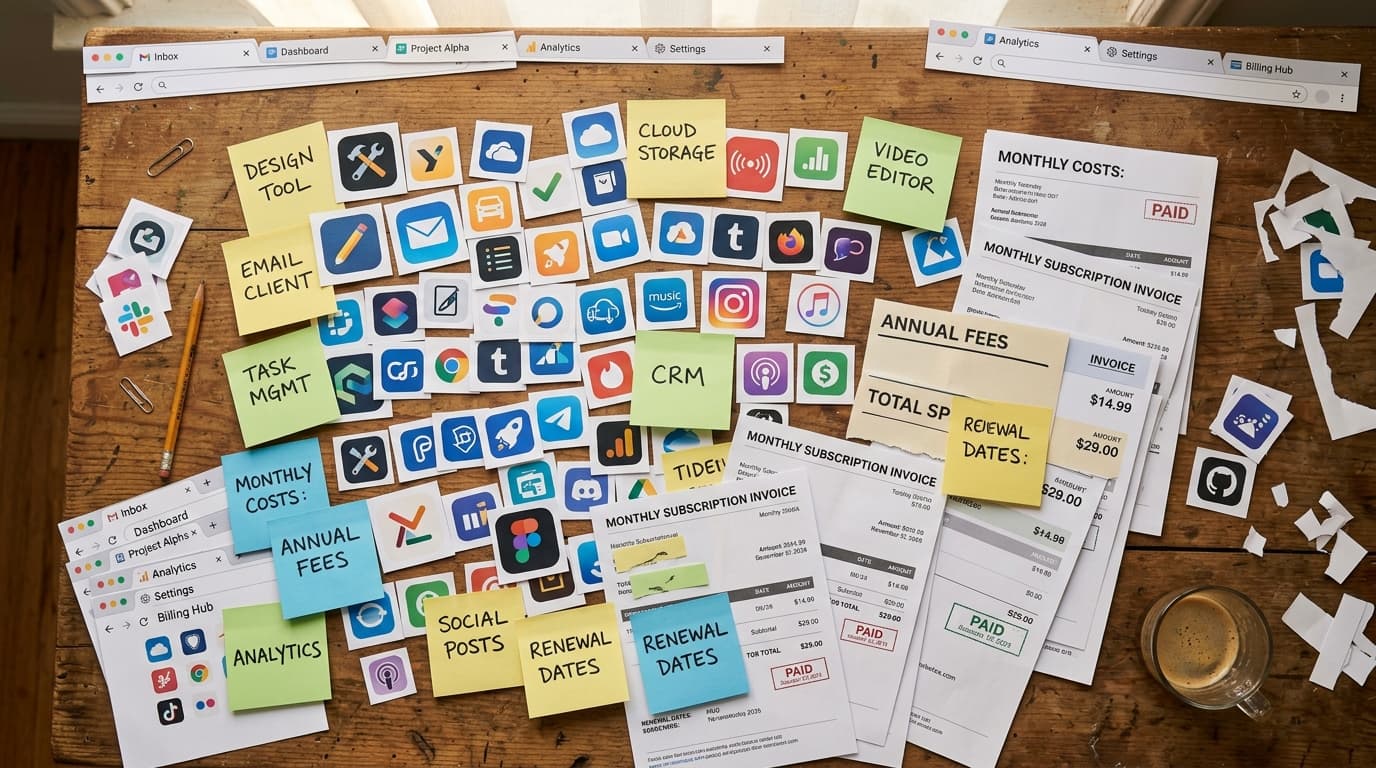

I organized my AI like a Fortune 500 company. Marketing department, sales department, operations, finance, legal, HR. 27 roles total. It looked impressive on a whiteboard.
Half of them never got used. And the ones that did? They didn't talk to each other. I had an AI agent writing marketing copy that had no idea what my sales process looked like. A finance agent that couldn't see what my delivery agent was building. I'd spent 18 years in corporate product management at Virgin Mobile, Papa Murphy's, and Intermedia, and I built the exact same broken structure with AI that I'd spent my career trying to fix with people.
The reason your AI tools don't work together isn't a technology problem. It's an org design problem. And the org chart you'd instinctively draw when organizing AI agents for your business is wrong.
Why Did I Organize My AI Like a Fortune 500 (and Why Was It the Worst Decision I Made)?
My instinct made sense at the time. I reached for what I knew: functional departments. I built 27 roles. Content writers, SEO specialists, social media managers, sales qualifiers, proposal builders, delivery coordinators, financial analysts. Every role had a detailed job description. Every department had a lead.
Here's what happened in practice.
My marketing agents produced content that had nothing to do with the conversations my sales agents were having. My delivery agents finished client work and nobody told the relationship agent to follow up. My finance agent tracked numbers but couldn't connect them to which stage of the client journey was actually generating revenue.
The problem wasn't the agents. The problem was the structure. Corporate org charts are built around functions. Marketing does marketing. Sales does sales. But in a founder-led business with 1 to 15 people, work doesn't flow by function. It flows by customer. A lead comes in, becomes a prospect, becomes a client, becomes a repeat buyer. The work follows that journey.
I had recreated the exact silo problem that made corporate life miserable. Except now the silos were made of AI. So I burned it down and started over.
Is the Real Problem Your AI Tools, or Your Org Chart?
If you've tried AI tools and they feel disconnected, you're not doing it wrong. You're organizing it wrong.
Most founders collect AI tools the same way they collect SaaS subscriptions. One for email, one for scheduling, one for content, one for data. Each works fine alone. None of them know the others exist. You end up being the connector, the coordinator, the memory holding it all together. You didn't automate your business. You just added more tabs.
Here's the thing. Your AI tools don't work together because most businesses organize them by function, with no shared structure connecting them. The problem is organizational design, not technology. When you organize agents around the customer lifecycle instead, handoffs between stages become natural rather than forced.
The "just add more tools" advice is everywhere. Pick the right tools. Start with a few use cases. Nobody tells you how to organize those tools into a system. And when you try, you default to the only organizational model you know: corporate departments.
Everyone already knows corporate structure is broken. Silos. Handoff gaps. Departments optimizing for their own metrics instead of the customer's outcome. So why would you replicate that in your AI?
What Is a Business AI Operating System?
A Business AI Operating System is a structured set of AI agents, workflows, and knowledge systems that run recurring business operations without the founder being the bottleneck. It replaces scattered AI tools with a unified system organized around how the business actually makes money.
I think of it in four layers. The first is Context: persistent knowledge about your business, your clients, your processes, your decisions. Without this layer, every AI interaction starts from zero. You re-explain your business every time. That context amnesia is the thing most founders experience as "AI doesn't work for me." It works fine. It just doesn't know you.
After Context comes Data (your actual business data, connected and queryable), Intelligence (agents that reason and surface patterns), and Automate (recurring workflows running without you). Each month, the build expands with new modules as the business grows.
Most founders are stuck at layer zero. They have tools but no context layer. No persistent knowledge. No organizational structure. Building an AI agent team for small business isn't about picking the right tools. It's about building the structure those tools plug into.
When I say "agentic AI" or "autonomous AI agents," I mean agents that carry their own knowledge and methodology. They don't need you to re-explain the job every time. They pick up where they left off. That's the difference between a digital workforce and a collection of chat windows.
How Does the ACRA Model Organize AI Agents Around Your Customer Lifecycle?
ACRA stands for Attract, Convert, Retain and Deliver, Ascend. It's a customer lifecycle framework for organizing AI agents in a small business. Instead of replicating a corporate org chart, ACRA groups agents by the stage of the customer journey they serve, with Finance and AI HR as shared support departments.
Attract brings potential clients to you. Content, social, SEO, brand visibility. One goal: get the right people to notice you.
Convert is where attention becomes a relationship. Discovery calls, proposals, qualification, follow-up. The handoff from "someone found your content" to "someone booked a call" should be one continuous motion, not a gap between two departments that don't share information.
Retain and Deliver is the actual work. Client onboarding, project delivery, quality assurance, technical execution. In a corporate org, this gets spread across operations, project management, QA, and support. In ACRA, it's one department. The client doesn't care about your internal structure. They care about getting what they paid for.
Ascend is the part most businesses forget entirely. Growing existing relationships. Upsells. Referrals. Long-term value. When this lives inside a "sales" department, it competes with new acquisition for attention and always loses. In ACRA, it gets its own department.
Four lifecycle departments. Two support departments. Six total. Every agent maps to one. The work flows the way the customer flows. Customer lifecycle automation means no orphan agents doing work that doesn't connect to a customer outcome.
What Changed When I Went from 27 Roles to 14 Agents?
Most founder-led businesses with 1 to 15 people need 10 to 20 specialized agents organized into 4 to 6 departments. The number matters less than the organizing principle. Agents organized around customer lifecycle stages outperform agents organized around corporate departments.
Here's what actually changed when I rebuilt.
I eliminated overlap first. My corporate model had separate agents for content strategy, content writing, content editing, and content distribution. Four agents, all in a "marketing" department. In ACRA, I have an Attract department with two agents: a lead and a specialist. Two agents doing the work that four couldn't coordinate.
I merged delivery functions. The old structure had separate agents for project management, client communication, technical delivery, and quality assurance. Four agents that constantly needed me to relay information between them. In Retain and Deliver, three agents share context. The delivery specialist knows what the technical specialist is building because they're in the same department with the same information.
I added what was missing. My corporate org had no Ascend function at all. No agent was responsible for growing client relationships after delivery. That's 18 years of corporate conditioning. In most companies, account management is an afterthought bolted onto sales. In ACRA, it's a first-class department.
The biggest change: every agent now carries embedded methodology. Each agent includes a "What I Know" section with the frameworks, processes, and decision criteria it needs. No agent asks me to re-explain how things work. The knowledge is built in, not stored in my head. That's what HBR means when they talk about "agent managers" (February 2026), except they're writing about enterprises supervising 50 to 100 agents. I'm talking about a founder with 14 that actually get used.
Why Does Customer Lifecycle Beat Corporate Departments?
Revenue alignment is the obvious reason. Every ACRA department maps directly to how your business makes money. No department exists that isn't connected to a customer outcome. Compare that to a corporate model where entire teams can optimize for internal metrics with no clear line to the bottom line.
But the less obvious win is handoff clarity. The biggest failure point in any multi-agent AI system is the handoff between agents. When a lead becomes a prospect, does your marketing agent pass that information cleanly to your sales agent? In most setups, no. The founder is the handoff. You're the one who remembers that a prospect mentioned something in a DM that should inform the proposal.
In ACRA, the handoff is structural. Attract hands to Convert. Convert hands to Retain and Deliver. Each transition follows the customer, not an arbitrary department boundary.
And then there's the orphan agent problem. In my 27-role model, I had agents that existed because they "should" exist. A legal agent. A compliance agent. They sat there with detailed job descriptions and almost never got used. A founder-led business doesn't have enough legal or compliance work to justify dedicated agents. In ACRA, every agent earns its seat by serving a specific lifecycle stage. If it doesn't serve the customer journey, it doesn't exist.
I ran both models. The lifecycle model caught three revenue opportunities in the first month that the corporate model missed entirely. Those opportunities lived in the gap between "sales" and "operations." In the ACRA model, that gap doesn't exist.
How Do You Build Your Own AI Agent Team?
Organize AI agents around your customer lifecycle, not around corporate departments. A customer lifecycle model ensures every agent maps to revenue, and nothing falls through the cracks.
Start with one lifecycle stage. Don't build all four at once. Pick the stage where you're losing the most time. For most founders, that's either Attract (content creation eats hours) or Retain and Deliver (delivery coordination is where you're most trapped).
Before you create a single agent, map the work. Write down every task that happens in that lifecycle stage. Not what you want to happen. What actually happens right now. Who does it. How long it takes. Where the information lives. This is the context layer, and skipping it is why most AI projects fail in month two.
Your first agent should carry everything it needs to do its job. Business context. The process it follows. The criteria it uses for decisions. The specific outputs it produces. If you have to re-explain things every time you use it, your context layer is missing.
Run that one agent for 30 days. Track what it handles, what it misses, what you still do yourself. Then build the next one. The ACRA model expands naturally because each lifecycle stage feeds the next. Once Attract is working, you'll see exactly what Convert needs.
If you're building a founder AI system from scratch, the ACRA model gives you the organizational architecture that most AI tools don't come with. The tools are the easy part. The structure is what makes them work.
What Is the Biggest Mistake Founders Make with AI Teams?
They copy what they already know.
The corporate org chart is the only organizational model most founders have ever used. So when they try to organize AI, they default to it. Marketing department, sales department, operations department. It's the model everyone's been trained on.
But a founder-led business isn't a corporation. The work doesn't flow by function. It flows by customer. And the organizing principle for your AI needs to match that reality, or you end up where I was. 27 roles. Half unused. The other half not talking to each other. And you're still the bottleneck holding it all together.
The shift is from organizing by what agents do (marketing, sales, operations) to organizing by who they serve (attract prospects, convert leads, deliver for clients, grow relationships). That one change turned my AI from a collection of disconnected tools into an actual system that runs without me coordinating every handoff.
Your AI doesn't need more tools. It needs an org chart that actually works.
If you're sitting on a pile of AI tools that don't talk to each other, the first step isn't another tool. It's a map. Where does your time actually go? Which lifecycle stage is eating the most hours? That's where your first ACRA department belongs.
I run a $2,500 AIOS Audit that maps exactly this. Two weeks. Full diagnostic of where your business runs through you and where a Business AI Operating System would give you back the most time. The $2,500 is deductible if you move into a full AIOS Setup. Book an AIOS Audit here.